
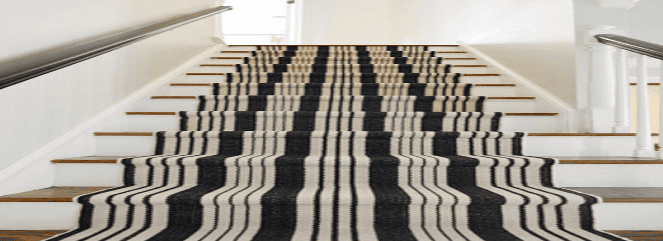
A straight flight is the easy case, and it is not what most Suffolk County houses have. Choosing Stair Runners in Suffolk County usually means dealing with a turn, a landing, treads of three different depths and a staircase that was built before anyone thought about carpet.
Weston Carpet & Rugs has been fitting runners out of our Norwell showroom for years, across Suffolk County and the South Shore. This is what we actually measure, what we recommend, and where we tell people a runner is not the right answer.
Quick Answers
How wide should a stair runner be?
Leave three to four inches of exposed tread on each side. On a 36 inch staircase that is a 27 to 30 inch runner, but the stairs decide it, not the standard sizes.
Can a runner go around a turn?
Yes. Winder or pie shaped steps are cut and fitted individually rather than run as one piece, which is more work but the only way it lies flat.
Waterfall or cap and band?
Waterfall drops straight over the nose and suits contemporary stairs. Cap and band wraps the nose and shows the stair profile, which suits older Suffolk County houses.
Do you install, or only supply?
Both. We measure, supply and fit, and we also handle carpet & rug repair in Barnstable County and across the South Shore when an existing runner is worth saving.
Why Boston Staircases Are Their Own Problem
The housing stock in Suffolk County is old, tall and narrow, and the stairs show it.
What makes these stairs different?
Four common staircase types and what each one demands.
| Staircase | Typical of | What it needs |
| Straight flight, uniform treads | Post war builds, some condos | A single run, simplest fit |
| Winders at the bottom or top | Triple deckers, Dorchester, Southie | Each pie step cut and fitted alone |
| Half landing mid flight | Brownstones, Back Bay, Beacon Hill | Runner broken and restarted at the landing |
| Open sided with a balustrade | Renovated town houses | One edge bound, the other tucked |
A quote that does not say which of these four you have is a quote for a different staircase, which is why we measure in person rather than over the phone.
What We Measure, and Why It Changes the Price
Runner pricing is not per stair. It is per linear foot of goods plus the labor the shape demands.
What actually drives the cost?
Six measurements that decide a Suffolk County runner job. The same math governs carpet in Plymouth County stair work.
- Tread depth and riser height: multiplied by the number of steps, this is the raw length before any waste.
- Winders: each pie step is a separate cut and a separate fit, so six winders cost more labor than twelve straight treads.
- Landings: a half landing usually means stopping the runner and starting again, and sometimes a separate bound piece.
- Pattern repeat: a stripe or a geometric has to line up step to step, which adds waste, exactly as it does with carpet in Plymouth County installations.
- Runner width: wider runners cost more and leave less tread showing, and on a narrow Boston stair that balance matters more than it does in a suburban hall.
- Finish: binding, serging or a wide edge tape changes both the look and the price, and we will show you all three.
Anyone quoting stair runners in Suffolk County without seeing the winders is guessing, and the guess is usually low.
Choosing the Material for a City Staircase
A stair runner takes more concentrated wear than any other floor covering in a Suffolk County house.
Which fiber holds up?
Six material decisions for a Suffolk County hall.
- Wool and wool blends: the traditional choice, resilient underfoot, and it recovers from crushing better than anything synthetic.
- Nylon: the hard wearing budget answer, and the right call for a rental or a busy family stair.
- Low pile over plush: a dense low pile holds the nose of the tread far better, and it does not show a traffic lane as fast.
- Pattern hides wear: a stripe or a small geometric disguises the path people actually walk, which a plain color will not.
- Sisal and flatweave: handsome, but hard on bare feet and unforgiving on a winder, so we steer people carefully here. The same stock serves our area rug store Plymouth County trade.
- Entry and porch steps: exterior steps are a different product entirely, and indoor outdoor carpet in Norfolk County or Suffolk is what belongs there, not a wool runner.
The Consumer Product Safety Commission publishes stair fall data worth a look, and slip resistance is a real part of this decision rather than a footnote.
When a Runner Is Not the Answer
We would rather talk a customer out of a runner than fit one that will look wrong in a year.
What are the alternatives?
Six honest cases, including where we send you elsewhere.
- Badly worn treads: fix the stairs first. A runner over a loose or split tread hides a hazard rather than solving it.
- You want the wood covered completely: that is full stair carpeting, not a runner, and we fit that too.
- You only want the landing softened: a bound area rug is cheaper and easier to lift, and our area rug store Plymouth County customers use us for exactly that.
- The runner you have is tired but good: re-binding or re-fitting is often worth it, which is the same skill as carpet & rug repair in Barnstable County work.
- Rental or short stay: a rod fitted runner lifts out without damaging the treads, and people searching stair runners near me for a rental usually want exactly this.
- Damp basement or bulkhead stairs: indoor outdoor carpet in Norfolk County specification handles moisture where a wool runner would not last a winter.
The City of Boston has guidance on work in historic districts that is worth checking before anything is fixed to an original staircase, and Mass.gov covers the wider building rules.
Getting Stair Runners Fitted in Suffolk County
Bring a photo of the Suffolk County staircase, or better, let us come and measure it. We will tell you how many winders you are dealing with, what the fit will cost, and which of the 300 plus runner styles in the range actually suit the stair rather than just the hallway.
Weston Carpet & Rugs, 412 Washington St., Norwell, MA 02061. Call (781) 659-0011, see the showroom and hours, or browse the stair runner range and book the complimentary in-home trial.
Call (781) 659-0011 to book a measure, or arrange the free in-home trial first.
If your treads need repair before anything is laid on them, we will say so before we quote. A runner is not a way to hide a bad stair.
Quick Summary
Choosing stair runners in Suffolk County is mostly a question of what shape the staircase is. Four types cover most Suffolk County houses: a straight flight with uniform treads, winders at the top or bottom of the run which are common in triple deckers, a half landing mid flight which is typical of brownstones and town houses, and an open sided stair with a balustrade where one edge has to be bound and the other tucked. Each pie shaped winder is cut and fitted individually rather than run as one piece, and that labor, not the number of steps, is what drives the price. The other cost drivers are tread depth and riser height, whether a landing breaks the run, the pattern repeat that has to line up step to step, the runner width, and the finish you choose between binding, serging and a wide edge tape. On width, leaving three to four inches of tread showing on each side is the usual guide, which puts a 36 inch staircase at a 27 to 30 inch runner. For material, wool and wool blends recover from crushing best, nylon is the hard wearing budget answer, a dense low pile holds the tread nose far better than a plush, and a stripe or small geometric hides the traffic lane a plain color will show. Exterior and damp steps need an outdoor specification instead. A runner is the wrong answer over worn or loose treads, when the whole stair should be carpeted, or when a bound rug on the landing would do the job.
Key Takeaways
- On a Suffolk County stair, the shape not the step count sets the price.
- Winders are cut and fitted one at a time. Budget for the labor.
- Leave three to four inches of tread showing on each side.
- Waterfall suits modern stairs, cap and band suits older Boston houses.
- Low pile wool or nylon outlasts plush on a stair nose.
- Pattern hides the traffic lane that a plain color will show.
- Fix a loose or split tread before a runner goes over it.
Frequently Asked Questions
1. How long does a stair runner installation take?
A straight flight is usually a few hours. Add winders or a landing and it becomes most of a day, because each shaped step is measured, cut and fitted on its own rather than being rolled out in one length.
2. Can a runner be fitted over existing carpet?
No. The old covering comes up first, the treads get checked, and any loose or damaged step is dealt with before the runner goes down. Laying over the top traps grit and shortens the life of the new runner.
3. Do you serve Boston, or only the South Shore?
Both. The showroom is in Norwell and we cover Suffolk County along with Plymouth, Norfolk, Barnstable and Essex. Searching for a rug store near me from Boston will bring you to us for exactly this work.
4. What happens to a runner when it wears at the nose?
It can often be lifted and shifted, or re-bound and re-fitted, which buys years. That is the same work as carpet & rug repair in Barnstable County and it is usually far cheaper than replacing the whole run.
5. Can I see the runner in my own house first?
Yes. The complimentary in-home trial exists for this. Colors read completely differently in a dim Boston stairwell than under showroom lighting, and a stair runner is not a purchase you want to judge from a swatch.